
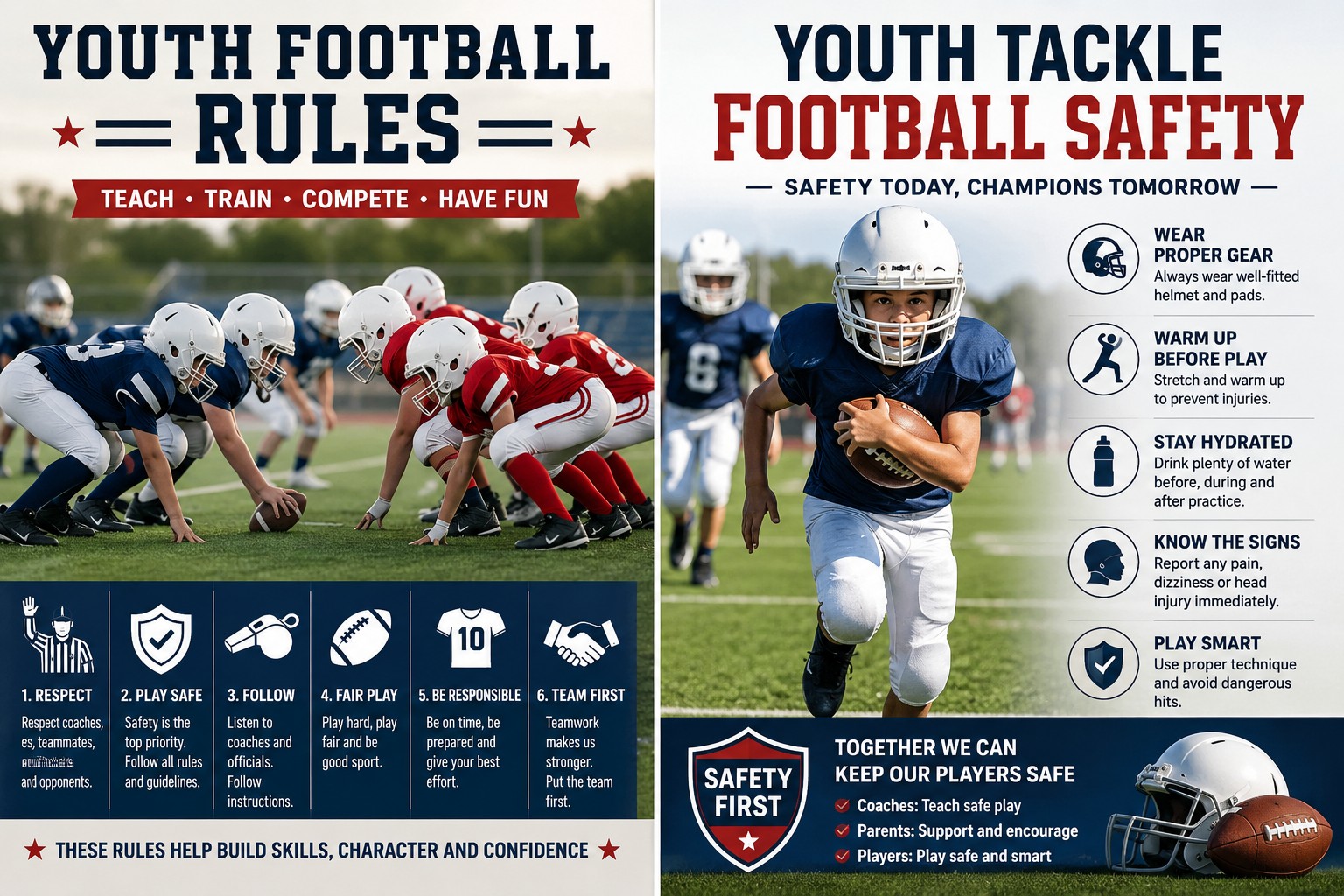
Youth Football Rules and Youth Tackle Football Safety: The Best Guide 2026 for Parents and Coaches
Introduction
Youth Football Rules and Youth Tackle Football Safety: Every fall, millions of kids lace up their cleats and head out to youth football fields across the country, and every parent standing on the sideline has the same two questions running through their mind: what are the actual youth football rules, and how safe is this sport really for my child? These aren’t small concerns. Football has changed a lot over the past decade, and so has the way leagues approach player development and protection.
Understanding youth football rules isn’t just about knowing when a flag gets thrown or how scoring works. It’s about understanding how leagues structure the game differently for young athletes than for high schoolers or professionals — smaller fields, modified contact rules, and stricter officiating around player safety. At the same time, youth tackle football safety has become one of the most researched and debated topics in youth sports, with leagues investing heavily in coach education, equipment standards, and injury-prevention protocols.
This guide walks through everything a parent, coach, or new player needs to know: why the rules matter, the different types of youth football programs and rule variations you’ll encounter, answers to the most common safety questions, and practical guidance for making an informed decision about your child’s participation. Whether your child is stepping onto a field for the first time or you’re a coach trying to run a program that keeps kids both engaged and protected, this article is built to give you a clear, complete picture.
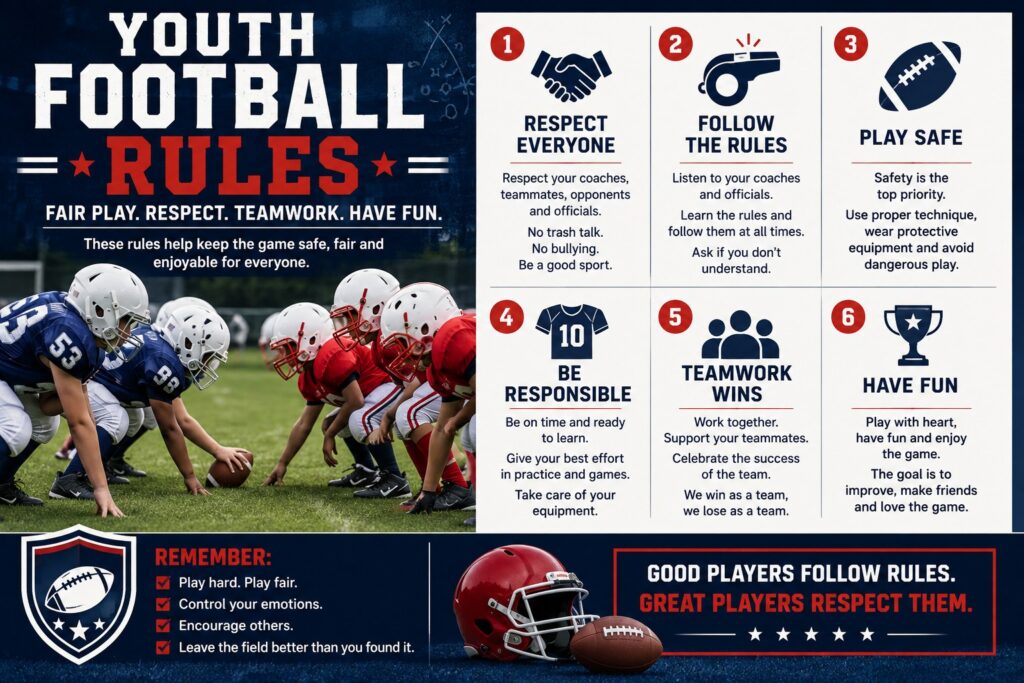
Why Youth Football Rules and Youth Tackle Football Safety Matter
It’s tempting to think of youth football as just a smaller, gentler version of the NFL. In reality, the rulebooks for youth leagues are built from the ground up around one central goal: protecting developing bodies while still teaching the fundamentals of the game. That’s why youth football rules differ so significantly from rules at the high school, college, or professional level.
The Physical Development Factor
Kids aren’t small adults. Their bones are still growing, their necks haven’t developed the muscle mass to stabilize repeated impacts, and their coordination is still catching up to their reflexes. This is the single biggest reason youth tackle football safety standards exist separately from adult football safety standards. Rules around contact intensity, practice structure, and equipment fit are designed specifically around these developmental realities.
Injury Prevention Isn’t Optional Anymore
A decade ago, many youth leagues operated with minimal oversight on things like padding standards or concussion protocols. That’s changed dramatically. Today, most reputable youth leagues require certified coaches, limit full-contact practice time, and mandate return-to-play protocols after any suspected head injury. These aren’t bureaucratic add-ons — they’re rules built directly from research on how repetitive sub-concussive impacts can affect a developing brain.
Rules Shape the Culture of the Team
Beyond the physical side, youth football rules also shape how the game is taught. Rules that mandate equal playing time, restrict blitzing schemes at certain age levels, or require “form tackling” certification for coaches all send a message: development and safety come before winning. Parents who understand these rules can better evaluate whether a league or team aligns with their values.
Legal and Insurance Considerations
Leagues that follow strict rule frameworks, particularly around youth tackle football safety, are also protecting themselves and participating families from liability gaps. Insurance providers increasingly require documented safety compliance — including baseline concussion testing, certified equipment, and trained medical staff at games — before covering a league at all. This has pushed nearly every serious youth program to formalize its rulebook.
Understanding these rules isn’t just useful — it directly affects whether your child has a positive, safe, and developmentally appropriate experience on the field.
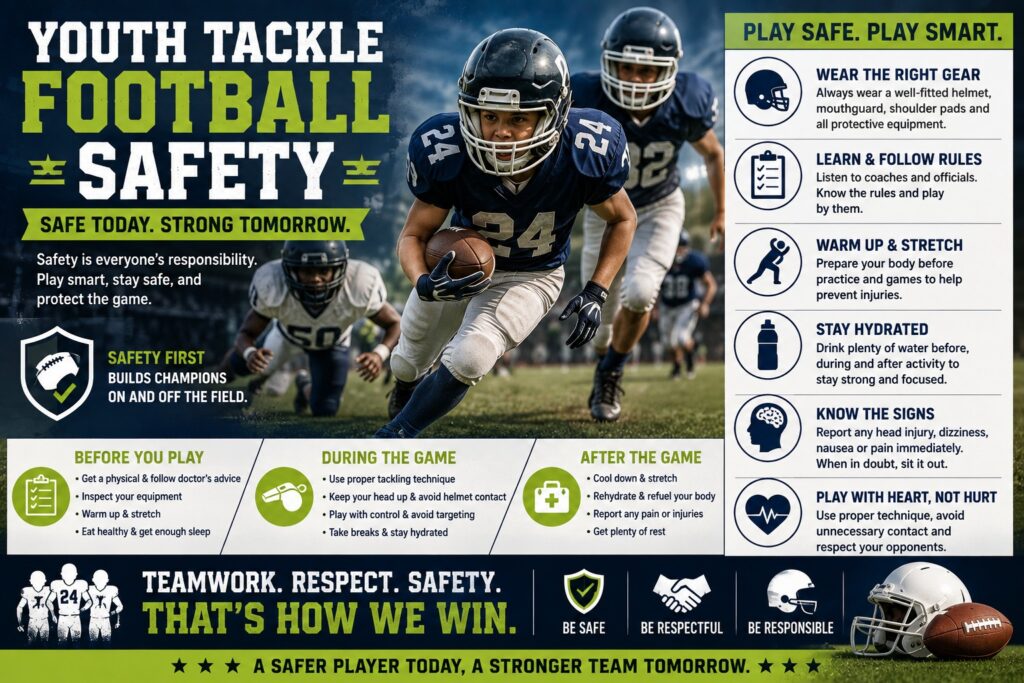
Different Types of Youth Football Rules and Safety Programs
Youth football isn’t a single, standardized system. Different organizations, age divisions, and regions apply their own variations of youth football rules and youth tackle football safety protocols. Here’s a breakdown of the major types you’re likely to encounter.
1. Flag Football Rule Systems
Flag football removes tackling entirely, replacing it with a flag-pull to end plays. It’s often the entry point for kids under age 7 or 8. Rules here focus on spatial awareness, ball handling, and basic positional understanding without any contact risk. Many leagues now treat flag football as a full multi-year track rather than just a stepping stone.
2. Modified (Rookie) Tackle Rules
Often used for the first year of tackle eligibility, modified tackle rules reduce field size, limit the number of players on the field (sometimes 6-on-6 or 8-on-8 instead of 11-on-11), and restrict certain formations like kickoffs or punt returns that create high-speed collisions.
3. Weight-Based Divisions
Instead of grouping kids strictly by age, many leagues use weight classes to ensure more even matchups. This is a critical youth tackle football safety measure, since a size mismatch between players is one of the leading contributors to injury risk in youth sports.
4. Age-Based Divisions
The more traditional structure, age-based divisions (e.g., 8U, 10U, 12U, 14U) organize players strictly by birth year. Some leagues combine this with weight limits for linemen to prevent oversized players from being used purely as battering rams.
5. USA Football’s “Rookie Tackle” Model
This nationally recognized model reduces the field to a smaller footprint, removes special teams contact (like kickoffs), and phases in more complex rules as players age up. It’s designed as a bridge between flag and full 11-on-11 tackle.
6. Heads Up Football Certification Programs
Rather than a rule set for gameplay itself, this is a coaching certification requirement adopted by many leagues. It mandates that all coaches complete training in proper tackling technique, concussion recognition, and heat safety before they’re allowed to coach.
7. Limited-Contact Practice Rules
Many state associations and national governing bodies now cap the amount of live, full-speed contact allowed in a single practice — often to as little as 30 minutes per week. This directly reduces the cumulative impact exposure tied to long-term brain health concerns.
8. Return-to-Play Protocols
These are safety-specific rules (not gameplay rules) that dictate what happens after a player shows signs of a concussion. A structured, multi-step return process — usually requiring medical clearance — is now standard across nearly every reputable league.
9. Equipment Standard Rules
Rules mandating NOCSAE-certified helmets, properly fitted shoulder pads, mouthguards, and regular equipment recertification fall under this category. Some leagues have also begun requiring or recommending additional helmet padding systems (like Guardian Caps) during practice.
10. Blitz and Formation Restriction Rules
At younger age levels, many leagues restrict blitzing, stacking the defensive line, or certain aggressive formations that create unpredictable, high-impact collisions for inexperienced players.
11. Mercy Rule and Sportsmanship Rules
While not directly safety-related, mercy rules (ending games early when the score gap becomes large) reduce unnecessary continued physical contact in games that are already decided, indirectly supporting player welfare.
12. Independent League vs. School-Affiliated Rules
Independent youth leagues (like Pop Warner or American Youth Football) often have their own national rulebooks, while school-affiliated youth programs may follow state athletic association guidelines instead. Both differ meaningfully in structure, insurance requirements, and safety mandates, so it’s worth comparing before enrolling.
Each of these rule categories works together to create a layered system, where gameplay rules, coaching standards, and medical protocols all reinforce the same underlying goal: a safer, more developmentally appropriate football experience.
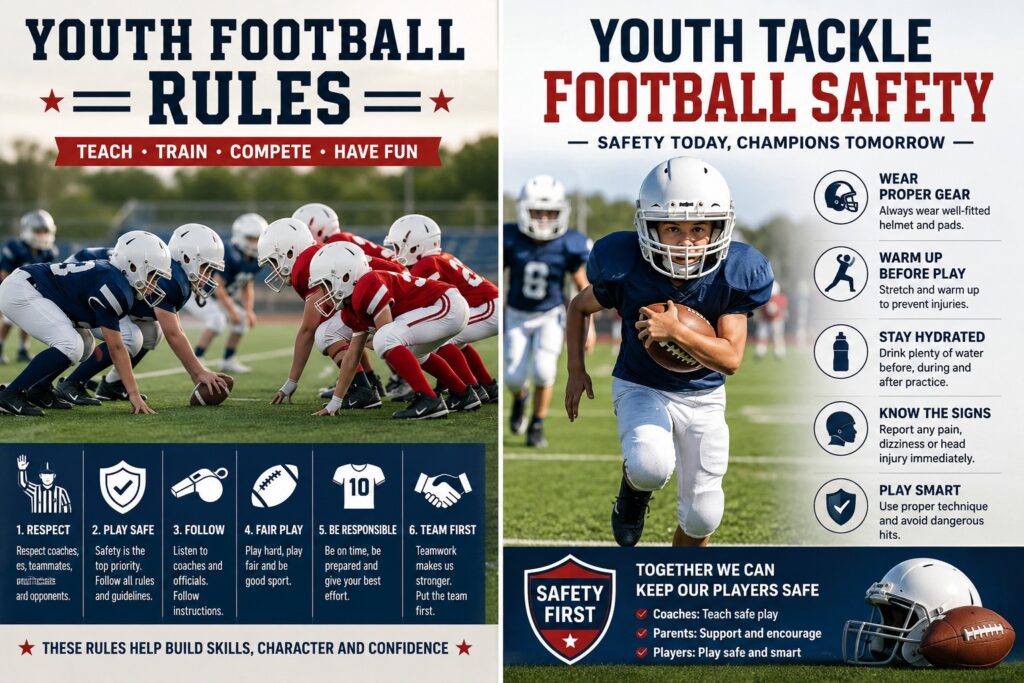
Frequently Asked Questions About Youth Football Rules and Safety
1. At what age can kids start playing tackle football?
Most leagues allow tackle football starting around age 6 to 8, though a growing number of programs recommend delaying tackle participation until age 10 or later, opting for flag football in the earlier years to build fundamentals without contact risk.
2. What is the biggest difference between youth and high school football rules?
Youth football rules generally include smaller fields, modified formations, weight or age restrictions, and stricter limits on full-contact practice time compared to high school rules.
3. How are concussions handled under current youth football rules?
Most leagues require an athlete suspected of a concussion to be removed from play immediately and cleared by a licensed medical professional before returning, following a graduated return-to-play protocol.
4. Is tackle football safer today than it was 10 years ago?
Significant safety improvements have been made, including limited-contact practice rules, coach certification requirements, and better equipment standards, though risk can never be fully eliminated in a contact sport.
5. What equipment is required by youth football rules?
Standard requirements include a NOCSAE-certified helmet, shoulder pads, mouthguard, and often additional padding such as hip, tailbone, and knee pads depending on league specifications.
6. Do youth leagues limit how much practice contact is allowed?
Yes, many leagues cap live-contact practice time weekly, often between 30 minutes to a couple of hours, to reduce cumulative impact exposure during the season.
7. What’s the difference between flag football and modified tackle football?
Flag football has no physical contact and uses flag pulls to end plays, while modified tackle football introduces contact but with a smaller field, fewer players, and restricted high-risk formations.
8. Are coaches required to be certified in youth football safety?
Most reputable leagues require coaches to complete a certification program covering proper tackling technique, concussion awareness, and emergency response before they’re permitted to coach.
9. How do weight-based divisions improve safety?
Weight-based divisions help prevent significant size mismatches between players, which reduces the risk of injury from collisions between athletes of dramatically different mass and strength.
10. What is a return-to-play protocol?
It’s a structured, medically supervised process that a player must complete after a suspected head injury before being cleared to return to practice or games, typically involving several symptom-free stages.
11. Can parents opt their child out of certain contact drills?
Many leagues allow parents to communicate concerns directly with coaches, and some programs offer modified participation plans, though policies vary significantly by league.
12. What organizations set national youth football rules?
Organizations like USA Football, Pop Warner, and American Youth Football publish widely adopted rulebooks, though local leagues can modify these to fit state or regional requirements.
13. How has heat safety become part of youth football rules?
Many leagues now include mandatory hydration breaks, heat-index-based practice modifications, and coach training on recognizing heat illness symptoms as part of official safety guidelines.
14. Do youth football rules address player-to-coach ratios?
Some leagues set minimum coach-to-player ratios, particularly for younger age divisions, to ensure proper supervision during both practices and games.
15. What should parents look for when choosing a safe youth football program?
Look for leagues with certified coaches, documented concussion protocols, weight or age-appropriate divisions, limited-contact practice policies, and transparent communication about safety procedures.
Conclusion
Youth football sits at an interesting crossroads: it’s a sport that teaches discipline, teamwork, and resilience, while also carrying physical risks that responsible leagues have worked hard to reduce. Understanding youth football rules gives parents and coaches the knowledge to evaluate programs critically, rather than assuming all leagues operate the same way. And prioritizing youth tackle football safety — through certified coaching, limited-contact practices, proper equipment, and structured medical protocols — has fundamentally changed what youth football looks like compared to a generation ago.
If you’re a parent weighing whether tackle football is right for your child, or a coach building a program from scratch, the rules covered in this guide offer a practical starting point. The safest, most positive youth football experiences happen when everyone involved — leagues, coaches, and parents — takes both the rulebook and the safety protocols seriously, not as a formality, but as the foundation the entire sport is built on.