Baseball Drills for Beginners And How to Master It: Best Guide 2026
Struggling to get the hang of baseball drills as a beginner? You’re not alone. Many people find it challenging to build the right skills and confidence on the field without feeling overwhelmed or stuck. Whether you want to improve your game or just enjoy playing more, mastering the basics is key—and that’s exactly what we’re here to help with.
To master baseball drills as a beginner, start with a proper warm-up that includes dynamic stretches and light cardio to prevent injuries. Focus on fundamentals like your grip, stance, and smooth throwing and catching mechanics.
Practice batting and pitching drills consistently. Build base running skills, and work on fielding with reaction exercises. Track your progress and avoid rushing or overtraining.
Stick to these basics, and soon you’ll fine-tune your skills and raise your game easily.
Baseball Drills for Beginners Key Takeaways
- Start with proper warm-up routines including dynamic stretching and hydration to prevent injuries and enhance performance.
- Master basic throwing, catching, and glove work by focusing on grip, stance, and consistent practice for muscle memory.
- Improve batting and pitching mechanics using targeted drills like tee swings, soft toss, and smooth arm motion for control and power.
- Develop base running skills and situational awareness through sprint mechanics, sliding techniques, and game scenario drills.
- Track progress with video and journaling, avoid rushing drills, and maintain focused, goal-oriented practice sessions with proper recovery.
How to Warm Up Properly for Baseball Drills

Before diving into baseball drills, you need to warm up properly to prevent injuries and improve your performance. Start with dynamic stretching routines that target your legs, arms, and core. Think leg swings, arm circles, and torso twists. These movements get your muscles ready and increase blood flow, helping you move more fluidly during drills.
Don’t skip light jogging or jumping jacks to raise your heart rate gradually.
Hydration tips are just as important. Drink water before, during, and after your warm-up to keep your body functioning at its best. Avoid sugary drinks that can dehydrate you. Aim to sip small amounts regularly rather than gulping large quantities at once.
Master Basic Baseball Throwing Technique
Once you’ve warmed up, focus on mastering the basic throwing technique. It’s essential for accuracy and power in baseball. Good form guarantees your throws are strong and precise. This keeps fans engaged and boosts your confidence on the field.
Remember, proper mechanics also reduce injury risks. That way, you can perform consistently without setbacks.
Here’s a simple breakdown to help you practice:
| Step | Action | Tip |
|---|---|---|
| Grip | Hold the ball firmly | Use fingertips, not palm |
| Stance | Feet shoulder-width | Balanced, knees slightly bent |
| Arm motion | Bring arm back, then forward | Follow through toward target |
| Release point | Let go at eye level | Aim for smooth, controlled throw |
Combine your throwing practice with good baseball nutrition to maintain energy and muscle strength. Staying sharp will keep fan engagement high, whether you’re on the diamond or cheering from the stands.
Catching Fundamentals Every Beginner Should Know
After you’ve nailed the throwing technique, it’s time to sharpen your catching skills. Start by adopting a solid catching stance, with feet shoulder-width apart, knees slightly bent, and weight balanced on the balls of your feet. This stance keeps you ready to move quickly in any direction.
Begin your catching journey with a balanced stance to stay quick and ready for any play.
Next, focus on glove positioning. Keep your glove relaxed and open, with your palm facing the ball’s path. For grounders, angle the glove slightly downward, and for fly balls, hold it above your waist with fingers pointing upward.
Always watch the ball into your glove to improve hand-eye coordination. Avoid stiffening your glove hand because staying loose helps absorb the ball’s impact. Remember, catching is about anticipation and reaction, so stay alert and ready to adjust your stance and glove positioning as needed.
Mastering these fundamentals will boost your confidence and reliability on the field.
Simple Drills to Improve Your Batting Swing
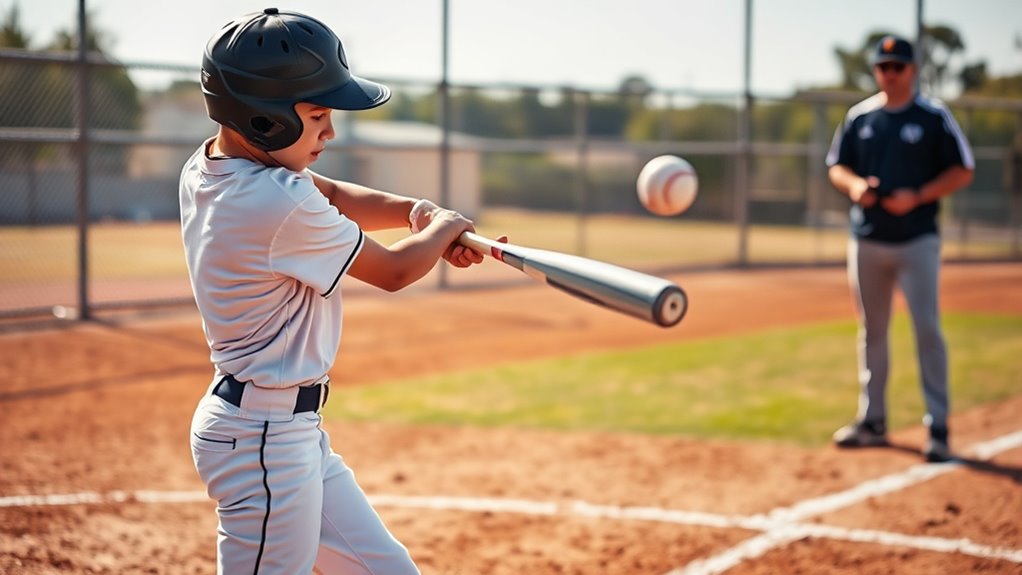
To improve your batting swing, you’ll want to focus on drills that build both power and precision. Increasing your bat speed and maintaining a consistent swing plane are essential. Start with tee drills to perfect your swing path, then move to soft toss to time your bat speed. Focus on keeping your swing level and controlled.
Here’s a quick guide to simple drills:
| Drill | Focus Area |
|---|---|
| Tee Drill | Swing plane |
| Soft Toss | Bat speed |
| Front Toss | Timing and control |
| Swing Path | Consistency |
| One-Hand Drill | Strength and speed |
Practice each drill regularly to develop muscle memory and improve your hitting mechanics. Remember, a smooth, quick swing with a proper plane leads to better contact and power. Keep your eyes on the ball and adjust your stance as needed to maintain balance throughout the swing.
How to Practice Base Running Efficiently
Although base running might seem straightforward, mastering it requires focused practice and attention to detail. To practice base running efficiently, start by working on your sprinting mechanics. Keep your body low, arms pumping, and take quick, powerful strides.
Master base running with focused practice: low body, pumping arms, and quick, powerful strides.
Efficiency tips include practicing your turns around bases to maintain speed without losing balance. Use drills like running from home to first base repeatedly, focusing on explosive starts and smooth progressions.
Next, practice reading the pitcher’s moves to get a quick jump off the base. Work on sliding techniques to avoid tags and stay safe.
Incorporate situational drills where you simulate game scenarios so you learn when to take risks or hold back. Consistent practice with these efficiency tips will improve your speed, decision-making, and overall base running. Remember, base running is as much about smart choices as it is about speed.
Improve Hand-Eye Coordination With Soft Toss Drills
Mastering base running sharpens your overall game awareness, but developing precise hand-eye coordination is just as important for hitting success. One of the best ways to boost this skill is through soft toss drills. By focusing on bat control and hand speed, you’ll make cleaner contact and react faster to pitches.
During soft toss drills, have someone gently toss the ball underhand from the side while you concentrate on swinging smoothly and timing your hit perfectly. This controlled environment lets you hone your:
- Reaction time, so you can adjust to different pitch speeds
- Bat control, enhancing your ability to direct the ball
- Hand speed, improving your quickness through the hitting zone
Consistently practicing soft toss drills will build muscle memory and confidence, helping you connect with the ball more often. Stick with it and you’ll notice your hitting game become sharper and more reliable.
Quick and Accurate Fielding Drills for Beginners
To field quickly and accurately, you’ve got to sharpen your reaction time and glove technique. Start by practicing drills that make you respond fast and position your glove right every single time.
With consistent effort, you’ll build the skills to handle any grounder or line drive with confidence. Keep at it, and soon it’ll feel natural out there!
Improving Reaction Time
When you want to field quickly and accurately, sharpening your reaction time is essential. Reaction speed helps you respond to the ball faster, giving you an edge in the game. Reflex training drills boost your ability to react instinctively, reducing hesitation.
To improve, focus on exercises that challenge your mind and body simultaneously:
- Use a reaction ball that bounces unpredictably to enhance hand-eye coordination and reflexes.
- Practice quick toss drills with a partner, forcing you to catch or field on the fly.
- Incorporate visual cue drills, like flashing lights or signals, to train your brain to react instantly.
Consistent practice of these drills will build your confidence and make you a more reliable fielder in every game situation.
Perfecting Glove Technique
Although it takes practice, perfecting your glove technique is key to fielding quickly and accurately. Start with basic catching drills to build hand-eye coordination and glove control.
Focus on soft hands. Absorb the ball gently to prevent it from bouncing out. Position your glove correctly, keeping it relaxed but ready.
Don’t forget glove maintenance. Regularly clean and condition it to keep the leather flexible and responsive. A well-maintained glove improves your grip and reaction time.
Practice short, quick catches to simulate real game situations, increasing your speed and confidence. By consistently working on these drills and caring for your glove, you’ll develop the quick, accurate fielding skills every beginner needs to succeed.
Keep practicing, and your glove work will become second nature.
How to Practice Pitching Basics for Beginners
To start pitching, you’ll want to focus on your grip and stance first. This helps you maintain control and balance. Then, practice the basic throwing mechanics, like your arm motion and follow-through. Getting these down will help you build consistency. Mastering these fundamentals is key because it sets the foundation for effective pitching.
Grip and Stance
Mastering your grip and stance lays the foundation for effective pitching. Your grip pressure must be firm but relaxed. Too tight, and your pitch loses control. Too loose, and it lacks power.
Adjust your stance width to maintain balance and stability. This sets you up for consistent delivery.
Focus on these key points:
- Find grip pressure that feels natural, boosting confidence with every throw
- Position your feet shoulder-width apart to stay grounded and agile
- Keep your body relaxed to prevent tension from affecting your motion
Basic Throwing Mechanics
When you start practicing pitching basics, focus on smooth, controlled movements that build muscle memory. Begin with a proper grip and stance, then work on your arm motion, ensuring a fluid follow-through. This helps improve accuracy and power while reducing strain.
Always prioritize injury prevention by warming up thoroughly and avoiding overuse. Pay attention to how your shoulder and elbow feel during practice. Discomfort signals you to adjust or rest.
Equipment selection plays a key role, too. Choose a ball and glove that fit your size and skill level to maintain proper mechanics. Consistently practicing these fundamentals will help you develop a reliable throwing motion, setting a strong foundation for more advanced pitching skills down the road.
Track Your Progress With These Baseball Drill Tips
Although practicing drills is essential, tracking your progress is what truly helps you improve. Keeping a close eye on your development sharpens your mental focus, allowing you to identify strengths and areas that need work. It also reinforces effective teamwork strategies by highlighting how well you coordinate with others during drills.
Tracking progress enhances focus, reveals strengths, and strengthens teamwork during drills.
To track your progress effectively, try these tips:
- Record your drill sessions with video to review your form and technique.
- Keep a journal noting daily improvements, challenges, and feedback from coaches.
- Set measurable goals for each practice, like increasing accuracy or speed.
Avoid Common Mistakes When Practicing Baseball Drills
Since practicing drills regularly builds your skills, avoiding common mistakes guarantees your efforts pay off. First, don’t rush through drills without focusing. Mental focus is key to mastering techniques and improving consistently. When you zone out, you risk ingraining bad habits that are hard to break later.
Also, never skip warm-ups or cool-downs. These are vital for injury prevention. Ignoring them can lead to strains or worse, sidelining your progress. Another common error is practicing without clear goals. Always set specific targets for each session to stay motivated and measure improvement.
Finally, avoid overtraining. Giving your body time to recover helps prevent burnout and injuries, ensuring you stay in the game longer. By staying mindful of these pitfalls, you’ll maximize your practice efficiency, improve your skills, and keep your body safe.
Frequently Asked Questions
What Equipment Is Essential for Beginner Baseball Drills?
You’ll need a good baseball glove to practice fielding positions and a sturdy bat to work on your batting stance. Don’t forget a helmet for safety while batting and a ball to hit and field.
Cleats help with traction during drills, and a batting tee can improve your swing mechanics. Having these essentials guarantees you focus on technique and build confidence as you master each drill effectively.
How Often Should Beginners Practice Baseball Drills Weekly?
You should practice baseball drills at least three to four times a week to improve your swing mechanics and fielding techniques effectively. Consistent practice helps build muscle memory and sharpens your skills faster.
Make sure each session focuses on specific areas, like hitting or fielding, so you don’t get overwhelmed. Remember, quality beats quantity. Short, focused practices will help you master the fundamentals without burning out.
Can Baseball Drills Help Prevent Injuries in Beginners?
Yes, baseball drills can help with injury prevention by teaching you proper techniques and improving your strength and flexibility. When you focus on safety tips during drills, like warming up correctly and using the right form, you reduce your risk of strains and sprains.
Consistently practicing these drills builds muscle memory, which keeps your body prepared and less prone to injuries as you play. So, drills aren’t just skill-building; they’re key for staying safe too.
What Is the Best Age to Start Baseball Drills?
The best age to start baseball drills? Obviously, when your toddler can swing a sippy cup like a pro—that’s peak youth development! Jokes aside, beginning around 5 to 7 years old helps you focus on skill progression without overwhelming your young player.
At this age, kids develop coordination and listen better, making drills both effective and fun. So, start early but keep it light to build a love for the game that lasts.
How Do Weather Conditions Affect Baseball Drill Practice?
Weather impact can seriously affect your baseball drill practice by changing field conditions and player comfort. When it’s rainy or windy, you’ll need to make practice adjustments like shortening drills or focusing on indoor skills.
Hot weather means you should schedule breaks and stay hydrated. Being flexible with your drills guarantees you keep developing skills safely and effectively, no matter what weather you face during practice.
Conclusion
If you master these baseball drills, you’ll practically become a legend overnight. Imagine the crowd roaring your name every time you step up to the plate!
Warming up, throwing, catching, batting, running, fielding, and pitching will feel like second nature. Just remember, avoiding common mistakes and tracking your progress will turn you from a beginner into an unstoppable force on the field faster than you can say “home run!”
Keep pushing—you’ve got this! Mastering baseball drills for beginners is your key to leveling up and owning the game.